


How Much Money Do You Need to Buy a House in Colombia?
- Juan Valdez
- 13 hours ago
- 8 min read

How Much Money Do You Need to Buy a House in Colombia?
Navigating the financial landscape of Colombian real estate is an invigorating journey, whether you dream of acquiring a modern condo in Medellín, a historic home in Cartagena, or rolling green acres dedicated to agricultural production. Many international buyers begin their search asking a simple question: how much cash do I actually need to get the deal done?
The answer extends far beyond the headline sticker price on a listing. Successfully purchasing real estate in Colombia requires a clear understanding of acquisition costs, municipal tax structures, closing expenses, and ongoing maintenance fees. As regional markets evolve and demand increases across prime territories in Antioquia and beyond, knowing how to break down your capital budget will protect your capital and empower your portfolio strategy. How Much Money Do You Need to Buy a House in Colombia?
1. Understanding Property Price Tiers Across Colombia
The primary factor determining your capital requirement is location and property type. Property values in Colombia vary significantly between primary urban centers, coastal tourist hubs, and picturesque rural valleys.
Urban Residential Markets
In major metropolitan centers, prices per square meter reflect access to commercial infrastructure, security, and amenities.
Medellín: High-demand areas like El Poblado and Laureles range between $1,800 USD and $3,500 USD per square meter. A comfortable two-bedroom apartment in these prime sectors generally costs between $130,000 USD and $250,000 USD. Neighboring municipalities such as Envigado and Sabaneta offer modern residential options starting around $90,000 USD to $160,000 USD.
Bogotá: Upper-middle-class and high-tier neighborhoods like Chapinero, Usaquén, and Los Rosales range from $2,000 USD to $3,500 USD per square meter. Standard apartments in these neighborhoods average between $150,000 USD and $300,000 USD.
Cartagena: The historical walled city (Centro) and coastal districts like Bocagrande represent the premium end of the market. Space here commands between $2,500 USD and $4,800 USD per square meter, pushing multi-bedroom luxury units well past $300,000 USD to $600,000 USD.
Countryside Estates and Agricultural Properties
For buyers seeking tranquility, self-sufficiency, or lifestyle production, rural real estate offers remarkable spatial value.
Rural Parcels and Small Country Houses: Entry-level rural properties, known locally as country homes or recreation parcels, can be found starting from $60,000 USD to $120,000 USD in lesser-known municipalities.
Coffee Properties and Agricultural Operations: Broadening your search to search terms like #FarmsForSaleInColombia, #ColombianCoffeeFarmsForSale, or #CoffeeFarmsForSaleColombia opens up traditional agricultural estates. A boutique working farm, often searched under #CoffeeFarmForSaleColombia, #CoffeeFarmsInColombiaForSale, or #ColombianLandForSale, generally ranges from $100,000 USD to $350,000 USD depending on topography, soil fertility, washing infrastructure, and house condition.
Premium Antioquia Estates: In heritage regions like the Southwest of Antioquia, a fully equipped #FincaForSaleColombia with panoramic mountain views and established harvests commands between $150,000 USD and $500,000 USD.
2. Closing Costs: What to Budget Beyond the Sale Price
A common mistake made by foreign investors is budgeting strictly for the purchase price. In Colombia, transaction costs are well-defined by law and custom, typically adding between 2.5% and 5% to your overall purchase budget.
Fee Category | Paid By | Estimated Percentage / Amount |
Notary Fees (Escrituración) | Split 50/50 | ~0.5% to 0.7% total (buyer pays half) |
Registration Tax (Impuesto de Registro) | Buyer | ~1.0% of purchase price |
Title Search & Legal Representation | Buyer | ~0.5% to 1.5% of purchase price |
Registry Office Fees (Beneficencia) | Buyer | ~0.5% to 1.0% depending on department |
International Banking / Transfer Fees | Buyer | Flat $100 USD – $500 USD per transaction |
Breakdown of Transaction Expenses
Notary Fees (Derechos Notariales)
By statutory standard, the public notary charges fees based on a government scale for processing the public deed (escritura pública). This fee typically averages around 0.54% to 0.70% of the declared contract value and is traditionally split equally between buyer and seller.
Registration Tax (Impuesto de Registro)
The registry office charges an official tax to record the transfer of title under your name in the public records. The buyer pays this fee, which usually sits at 1.0% of the sale price.
Legal Due Diligence (Estudio de Títulos)
Never purchase real estate in Colombia without an independent attorney conducting a thorough title search over the 20-year chain of title. A reliable lawyer will charge between 0.5% and 1.5% of the property value, or a fixed flat fee ranging from $1,000 USD to $2,500 USD depending on property complexity. This inspection verifies that no active liens, mortgages, land reform restrictions, or boundary disputes impact the asset.
3. Financing vs. Cash: Capital Deployment Realities
Understanding how you will fund the purchase is critical to setting your starting capital threshold.
Cash Transactions (The Standard Route)
The majority of foreign transactions in Colombia are completed entirely in cash via wire transfers. Colombian banking regulations require all foreign currency entering the country for real estate transactions to be properly routed through the legal exchange market (Mercado Regulado).
Your foreign currency must be declared to the Central Bank (Banco de la República) using Form No. 4 or its digital equivalent. This step registers your initial capital as Foreign Direct Investment (FDI), ensuring you can legally repatriate your funds and profits when you sell the property in the future.
Local Mortgages for Foreigners
While obtaining local financing as a non-resident is legally possible, it is practically challenging and often financially disadvantageous.
High Interest Rates: Local mortgage rates in Colombia historically sit higher than those in North America or Europe, often running in the double digits.
Strict Income Verification: Colombian financial institutions require extensive proof of locally generated income or extensive residency documentation.
Low Loan-to-Value (LTV): If approved, non-resident buyers are rarely offered more than a 50% to 60% LTV, requiring at least a 40% to 50% cash down payment plus all closing costs.
For these reasons, most foreign buyers leverage home equity loans or cash reserves from their home countries to purchase outright in Colombia.
4. Ongoing Carrying Costs: Holding Your Asset
Once you take possession of your home or farm, your ongoing annual holding costs are relatively moderate compared to international standards.
[Purchase Capital] ---> [Closing Costs (2.5%-5%)] ---> [Annual Holding Costs (Tax + HOA + Utilities)]
Annual Property Tax (Impuesto Predial Unificado)
Municipal property taxes are billed annually or quarterly. The rate ranges from 0.3% to 3.3% based on the cadastral valuation (avalúo catastral) of the property rather than the commercial market value. Because cadastral values are frequently lower than market values, annual property taxes are generally manageable, often coming in between $200 USD and $1,200 USD per year for mid-to-upper tier homes.
HOA Fees (Administración)
If your property is located within a gated rural community (unidad cerrada) or an urban apartment building, you will pay monthly HOA fees. These fees cover security personnel, common area maintenance, pool cleaning, and land maintenance.
Urban Condos: $80 USD to $250 USD per month.
Rural Gated Estates: $100 USD to $300 USD per month depending on shared amenities.
Utilities and the Estrato System
Colombia categorizes residential properties into socioeconomic tiers rated from 1 to 6, known as estratos.
Estratos 1 to 3: Receive government subsidies on public utilities (water, electricity, gas).
Estrato 4: Pays the neutral, baseline rate.
Estratos 5 and 6: Pay a surcharge on utility bills to subsidize lower tiers.
Most modern homes catering to foreign investors sit in Estrato 4, 5, or 6. Monthly utilities for a standard two-bedroom home in these tiers typically range from $70 USD to $180 USD.
5. Strategic Region Highlight: Southwestern Antioquia
While urban hubs like Medellín attract significant attention, experienced investors are shifting their focus toward the dramatic mountain landscapes of Southwestern Antioquia.
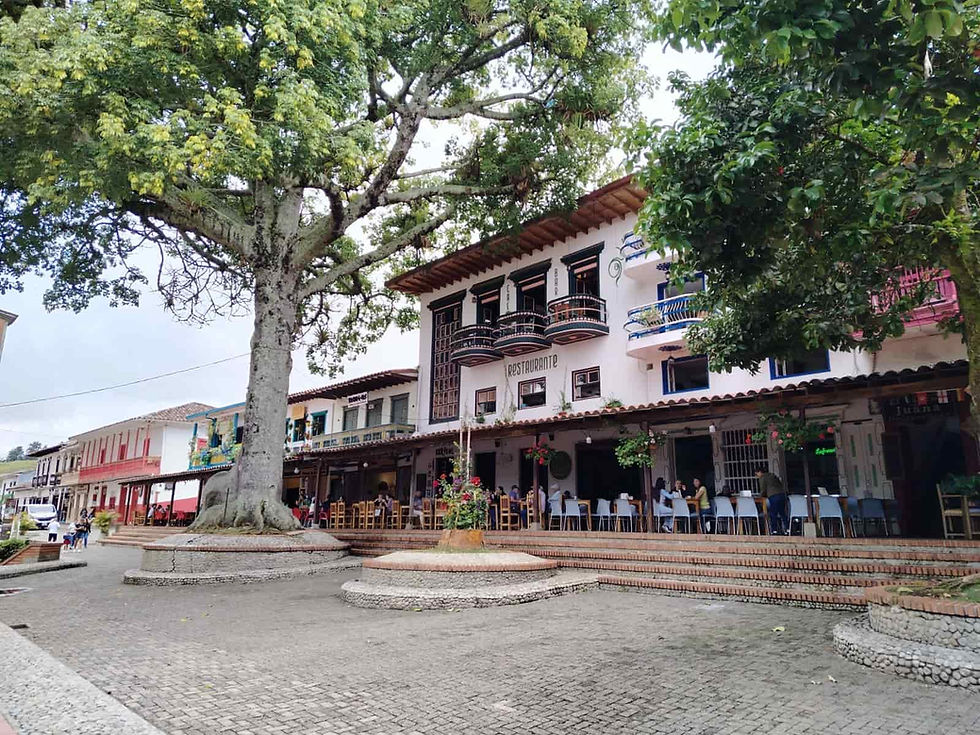
Towns like Jericó stand out for their exceptional coffee culture, preserved colonial architecture, and booming eco-tourism potential. Whether you are searching for dedicated coffee production acreage or a private mountain refuge, this area offers high growth potential alongside an unmatched quality of life.
Why Jericó and the Surrounding Region?
Accessible Entry Points: High-quality rural parcels and charming colonial homes can be secured at lower prices per square meter than saturated city markets.
Agricultural Yield: Properties in this region benefit from world-renowned soil conditions, perfect for those interested in high-yield specialty coffee farming.
Infrastructure Upgrades: Highway developments across Antioquia continue to shorten drive times from Medellín, accelerating property appreciation across the Southwest.
Working with local specialists ensures you navigate municipal land regulations (Plan de Ordenamiento Territorial), water rights (concesión de aguas), and boundary verifications seamlessly.
The Expertise You Need in Antioquia
Real estate acquisitions require local intelligence, specialized teams, and trusted market relationships. At Jerico Colombia Real Estate, we offer new perspectives and expert skills tailored to help private buyers and international investors successfully navigate the market.
We have the hottest properties in Jericó and we have the hottest properties in Antioquia. From boutique agricultural parcels to luxury rural retreats, our specialized teams handle every step of the transaction—offering outsourced marketing services and comprehensive due diligence guidance designed to help businesses achieve greater returns. When you are ready to #InvestInColombia, #InvestInColombiaRealEstate, or begin #BuyingPropertyInColombia, our local expertise is your strongest advantage.
Conclusion
So, how much money do you actually need to buy a house in Colombia?
If your target is a modern apartment in a primary city, a starter budget of $100,000 USD to $180,000 USD provides excellent choices. If your target is an authentic rural estate or agricultural farm, entry points can range from $120,000 USD for modest parcels up to $400,000 USD+ for expansive, fully operational coffee estates. Always remember to add 3% to 5% on top of your target property price to comfortably cover legal fees, title searches, notary expenses, and tax registrations.
By planning your capital deployment thoughtfully, registering your money correctly with the Central Bank, and partnering with verified regional experts, #Colombia offers one of the most rewarding real estate landscapes in the world. Explore your options today, reach out to specialized advisors, and discover what makes #JericoColombia one of the most exciting property destinations in Latin America. Visit Jerico Colombia Real Estate to start your search.
Frequently Asked Questions (FAQs)
What is the minimum amount of money I need to buy a home in Colombia?
While modest apartments in secondary cities or smaller towns can be found for as little as $40,000 USD to $60,000 USD, foreign buyers looking for renovated homes, secure neighborhoods, or good rental demand typically spend between $90,000 USD and $180,000 USD.
Can I get a Colombian residency visa by buying property?
Yes. Colombia offers an Migrant Investor Visa (M-type) for real estate purchases. The minimum investment threshold is tied to the official minimum monthly wage in Colombia (typically requiring an investment equal to 350 times the monthly minimum wage, which generally translates to around $110,000 USD to $130,000 USD depending on exchange rates). The investment must be officially registered with the Banco de la República.
How do I safely send money to Colombia to purchase real estate?
You must send funds from your foreign bank account via international wire transfer directly to a brokerage account or a Colombian bank account opened in your name. The transfer must be declared to the Central Bank using exchange forms to register the transfer as foreign direct investment. Never transfer funds informally or through unregistered channels.
Are property taxes high in Colombia?
No. Annual property taxes (Impuesto Predial) are moderate, ranging between 0.3% and 3.3% of the municipal cadastral value. Because cadastral values are often significantly lower than commercial market prices, annual tax bills for typical residential homes usually fall between $200 USD and $1,200 USD per year.
Is it safe for a foreigner to buy rural land or coffee farms?
Yes, foreign nationals enjoy the same constitutional property rights as Colombian citizens. However, buying rural land requires specialized legal checks to ensure the property does not fall under restricted state-granted land categories (baldíos), does not violate Agricultural Family Unit (UAF) boundaries, and possesses clear environmental and water usage permits.
What extra costs should I expect when buying a farm or rural estate?
In addition to standard closing costs (2.5% to 5%), rural property buyers should budget for a professional topographic survey (levantamiento topográfico) to confirm fence boundaries, as well as an inspection of water sources, septic systems, and agricultural infrastructure.
#RealEstate Jerico Antioquia


Comments